"It’s hard to escape a visit to India without someone asking you to compare it to China. This visit was no exception, but I think it’s more revealing to widen the aperture and compare India, China and Egypt. India has a weak central government but a really strong civil society, bubbling with elections and associations at every level. China has a muscular central government but a weak civil society, yet one that is clearly straining to express itself more. Egypt, alas, has a weak government and a very weak civil society, one that was suppressed for 50 years, denied real elections and, therefore, is easy prey to have its revolution diverted by the one group that could organize, the Muslim Brotherhood, in the one free space, the mosque. But there is one thing all three have in common: gigantic youth bulges under the age of 30, increasingly connected by technology but very unevenly educated."Read the rest of Friedman's column. It is worth reading and thinking about because the impact over the next 10, 20, and 30 years will be bigger than people realize.
Showing posts with label India. Show all posts
Showing posts with label India. Show all posts
Wednesday, February 6, 2013
Friedman: India vs. China vs. Egypt | NYTimes.com
Another interesting column by Tom Friedman. Here is the premise:

Wednesday, January 18, 2012
The Science of How We Walk | The Atlantic Cities
Disorganized Indians are more efficient than organized Germans? This article explains the only scenario in which that make sense.
Wednesday, January 11, 2012
A skyscraper boom in India?
Yes, a skyscraper boom in India. However, Bloomberg is cautioning that it could be a sign of a bubble.
Thursday, January 5, 2012
India's Infrastructure Woes
A very interesting analysis in The Economist about the current infrastructure issues facing India today:
"For the past half decade India’s infrastructure industry has enjoyed a Sea Link moment; a blast of growth when one could imagine that the private sector could deliver all the new roads, bridges, power stations and airports that the country needs so badly. The government says the boom will continue. Over the next five years it predicts that infrastructure investment will reach a new high relative to GDP, with some $1 trillion spent, half of it by the private sector. The trouble with this rosy prediction is that the balance-sheets of many Indian infrastructure firms are as potholed as the roads they resurface."
That Sea Link bridge in Mumbai is pretty sweet though:
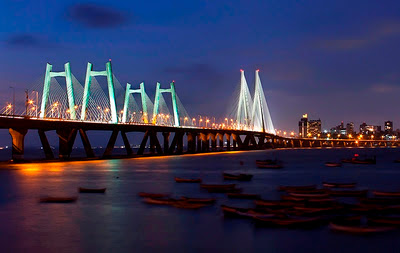
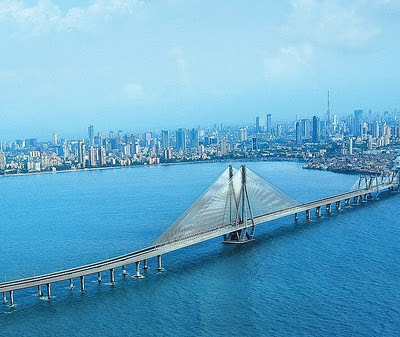
"For the past half decade India’s infrastructure industry has enjoyed a Sea Link moment; a blast of growth when one could imagine that the private sector could deliver all the new roads, bridges, power stations and airports that the country needs so badly. The government says the boom will continue. Over the next five years it predicts that infrastructure investment will reach a new high relative to GDP, with some $1 trillion spent, half of it by the private sector. The trouble with this rosy prediction is that the balance-sheets of many Indian infrastructure firms are as potholed as the roads they resurface."
That Sea Link bridge in Mumbai is pretty sweet though:


Thursday, December 8, 2011
ESPNcricinfo: India batsman tops highest 1-day cricket score
The best way to explain this event to baseball fans would be imagine a guy going 6-for-6 with three grand slams and 15 RBI's in ONE baseball game. That's how big a deal this is.
Thursday, November 3, 2011
R.A. Dickey Partnering With Bombay Teen Challenge
Let's Go Mets! New York Mets knuckleballer R.A. Dickey will be partnering with Bombay Teen Challenge this January to end human trafficking in Mumbai. Check out the video:
Wednesday, November 2, 2011
Alexander the Great, Genghis Khan, and that's pretty much it.
If you read Afghanistan's history, the only men to conquer this essentially landless region were Alexander the Great and Genghis Khan. Everyone else pretty much failed miserably. Tom Friedman references that with yet another excellent column in today's New York Times:
"Last week, I toured the great Mogul compound of Fatehpur Sikri, near the Taj Mahal. My Indian guide mentioned in passing that in the late 1500s, when Afghanistan was part of India and the Mogul Empire, the Iranian Persians invaded Afghanistan in an effort to “seize the towns of Herat and Kandahar” and a great battle ensued. I had to laugh to myself: “Well, add them to that long list of suckers — countries certain that controlling Afghanistan’s destiny was vital to their national security.”"
The rest of Friedman's column is worth reading as well.
"Last week, I toured the great Mogul compound of Fatehpur Sikri, near the Taj Mahal. My Indian guide mentioned in passing that in the late 1500s, when Afghanistan was part of India and the Mogul Empire, the Iranian Persians invaded Afghanistan in an effort to “seize the towns of Herat and Kandahar” and a great battle ensued. I had to laugh to myself: “Well, add them to that long list of suckers — countries certain that controlling Afghanistan’s destiny was vital to their national security.”"
The rest of Friedman's column is worth reading as well.
Friday, September 2, 2011
India's Great Middle-Class Moment - The Atlantic
Interesting piece in The Atlantic:
"There are many uncertainties in the short-term. But, to the extent that India's political and social churning was led by Middle India and its changing expectations, its politicians will have to re-craft their agenda, which currently has little to offer them."
"There are many uncertainties in the short-term. But, to the extent that India's political and social churning was led by Middle India and its changing expectations, its politicians will have to re-craft their agenda, which currently has little to offer them."
Thursday, May 12, 2011
Pushing Pakistan to act
A couple of stinging columns from Fareed Zakaria (an Indian-born Muslim-American) and Zalmay Khalilzad (an Afghan-born Muslim-American).
Zakaria quotes someone telling him:
""It's like a person, caught in bed with another man's wife, who is indignant that someone entered his house," one Pakistani scholar, who preferred not to be named for fear of repercussions, told me."
whereas Khalilzad writes:
"The killing of Bin Laden only 60 miles from Islamabad, its capital, has put Pakistan on the defensive, and the nature of our strike capability is not lost on Pakistani leaders and their terrorist and insurgent clients."
Perhaps Pakistan should be worried about the Muslims from its neighboring countries that are growing more and more skeptical of it than what the United States wants to do with it?
Zakaria quotes someone telling him:
""It's like a person, caught in bed with another man's wife, who is indignant that someone entered his house," one Pakistani scholar, who preferred not to be named for fear of repercussions, told me."
whereas Khalilzad writes:
"The killing of Bin Laden only 60 miles from Islamabad, its capital, has put Pakistan on the defensive, and the nature of our strike capability is not lost on Pakistani leaders and their terrorist and insurgent clients."
Perhaps Pakistan should be worried about the Muslims from its neighboring countries that are growing more and more skeptical of it than what the United States wants to do with it?
Monday, April 18, 2011
"We'll make it. Just don't ask me how."
Washington Post columnist Steven Pearlstein wraps up his two-week sojourn to India with a wrap-up of where India has been and where she's headed. In the end, there is a sense of reserved optimism or hopeful pessimism in India, which goes hand-in-hand with the quote that I used for the title of this post, "We'll make it. Just don't ask me how."
The blurb from the article that stood out for me, for personal reasons, was:
"Cummins, the big U.S.-based engine company, has had a plant in Pune since 1962, and demand for its products are so brisk that it will open a second, bigger production campus 90 miles away."
My family comes from Pune and my father had a job offer from Cummins in 1970. He had also just gotten an immigration visa to the United States and decided to turn down the Cummins job offer and move to the United States instead. It's kind of nice to see Cummins still operating in Pune and still holding the same presence that I had always heard about.
The blurb from the article that stood out for me, for personal reasons, was:
"Cummins, the big U.S.-based engine company, has had a plant in Pune since 1962, and demand for its products are so brisk that it will open a second, bigger production campus 90 miles away."
My family comes from Pune and my father had a job offer from Cummins in 1970. He had also just gotten an immigration visa to the United States and decided to turn down the Cummins job offer and move to the United States instead. It's kind of nice to see Cummins still operating in Pune and still holding the same presence that I had always heard about.
Friday, April 15, 2011
India needs Wal-Mart? Perhaps/Perhaps Not.
The Economist has an interesting blog post that suggests India could transform its retail sector by opening up foreign direct investment to firms like Wal-Mart. There are two ways to look at this. Wal-Mart will either take advantage of its legitimate supply chain management and illegitimate business practices to end up becoming the only game in town, much like it has done in small-town America OR Wal-Mart’s reputation for unethical business practices combined with its leverage could be the only thing capable of taking on and taking down the hideously corrupt Indian bureaucracy.
The thing is politicians in India have two gravy trains:
1) Rural villagers exploited into thinking they’re going to be exploited by foreigners or urban Indians.
2) Wealthy interests greasing the politicians’ palms to get what they want at the expense of everyone else not willing/able to pay a bribe.
Neither of these is conducive to Wal-Mart ending up in India, regardless of whether you think it will be a blessing or a curse.
The thing is politicians in India have two gravy trains:
1) Rural villagers exploited into thinking they’re going to be exploited by foreigners or urban Indians.
2) Wealthy interests greasing the politicians’ palms to get what they want at the expense of everyone else not willing/able to pay a bribe.
Neither of these is conducive to Wal-Mart ending up in India, regardless of whether you think it will be a blessing or a curse.
Friday, December 10, 2010
If you scratch my back...
It's kind of embarrassing for India that the three countries ahead of it for having the most prevalent cultures of bribery are Liberia, Afghanistan, and Iraq: one country artificially created by the United States in the 19th century that is forever enthralled in political turmoil and two countries where the United States has actively engaged war recently. Perhaps this means the reason we Americans are so far down on the list is because we tend to export bribery inducement to other places?
On the other hand, considering India's economic progress over the past decade or so, I'd be curious to know if this percentage has actually decreased over that period.
On the other hand, considering India's economic progress over the past decade or so, I'd be curious to know if this percentage has actually decreased over that period.
Friday, November 12, 2010
Dog Bites Man; Man Bites Dog
The "Dog Bites Man" story: China, Brazil, and India are the best places for investors.
The "Man Bites Dog" story: Washington Post columnist Charles Krauthammer writes positively about something that involves President Obama, specifically the cost of his trip to India and why it was justified.
The "Man Bites Dog" story: Washington Post columnist Charles Krauthammer writes positively about something that involves President Obama, specifically the cost of his trip to India and why it was justified.
Tuesday, October 5, 2010
“India and China, China and India; Elaine and Susie, Susie and Elaine”
(In case you didn’t get the Seinfeld reference.)
A couple of articles about India and China recently, related to population growth, economic growth, and issues related to economic growth. A few passages that stand out:
“The Indian government recognises the need to tackle the infrastructure crisis, and is getting better at persuading private firms to stump up the capital. But the process is slow and infected with corruption. It is hard to measure these things, but many observers think China has done a better job than India of curbing corruption, with its usual brutal methods, such as shooting people.” {emphasis mine}
“Many universities turn out graduates who are good at exams but unaccustomed to thinking about real-world problems.”
I have many personal anecdotes that corroborate this 2nd statement but will not make them here openly. I have a feeling that the people that will be offended by this statement are exactly the people I’m thinking about.
A couple of articles about India and China recently, related to population growth, economic growth, and issues related to economic growth. A few passages that stand out:
“The Indian government recognises the need to tackle the infrastructure crisis, and is getting better at persuading private firms to stump up the capital. But the process is slow and infected with corruption. It is hard to measure these things, but many observers think China has done a better job than India of curbing corruption, with its usual brutal methods, such as shooting people.” {emphasis mine}
“Many universities turn out graduates who are good at exams but unaccustomed to thinking about real-world problems.”
I have many personal anecdotes that corroborate this 2nd statement but will not make them here openly. I have a feeling that the people that will be offended by this statement are exactly the people I’m thinking about.
Friday, August 20, 2010
"India conquered and dominated China culturally for 20 centuries without ever having to send a single soldier across her border."
The relationship of China and India seems to be the topic du jour again for The Economist. Earlier this week I blogged about the historical presence of China and India in the global economy. Now The Economist has not one but two articles on the relationship (or perhaps lack thereof) between China and India.
For some reason though, what comes to my mind after reading both of these is the humility expressed in this quote by Hu Shih, former Ambassador of China to USA: "India conquered and dominated China culturally for 20 centuries without ever having to send a single soldier across her border."
For all of the two countries’ posturing over the last five decades, Hu Shih’s quote makes me feel like there is a begrudging mutual respect based on over 2,000 years of history that is not going to go away in light of or in spite of current events.
For some reason though, what comes to my mind after reading both of these is the humility expressed in this quote by Hu Shih, former Ambassador of China to USA: "India conquered and dominated China culturally for 20 centuries without ever having to send a single soldier across her border."
For all of the two countries’ posturing over the last five decades, Hu Shih’s quote makes me feel like there is a begrudging mutual respect based on over 2,000 years of history that is not going to go away in light of or in spite of current events.
Tuesday, August 17, 2010
"...China and India were the biggest economies in the world for almost all of the past 2000 years."
Go to the post on economist.com to see the graph. It shows that over the past 2,000 years, China and India were the dominant economies for the first 1,700 of those years. Thomas L. Friedman once said that the emergence of China and India is not a new world order but rather the restoration of the old world order. This graph proves that to be true.
Thursday, July 15, 2010
The "New" Indian Rupee
If you saw this blog post from March 2009, The Rachel Maddow Show did a story on how the Indian Rupee has no international symbol like the dollar, pound sterling, or yen. There was a contest to create a new Rupee symbol and the winner and symbol were announced today.
Congratulations Indian Rupee! And welcome to the international community of depressed currencies!
Congratulations Indian Rupee! And welcome to the international community of depressed currencies!
Saturday, November 28, 2009
NYT: India's Eternal Crisis
Column from Saturday's New York Times
"India may have been passive after the Mumbai attacks. But India has not launched wars against either abstract nouns or actual countries that it has no hope of winning or even disengaging from."
War against an abstract noun. How true!
"India may have been passive after the Mumbai attacks. But India has not launched wars against either abstract nouns or actual countries that it has no hope of winning or even disengaging from."
War against an abstract noun. How true!
Subscribe to:
Posts (Atom)